
The Benefit of push up

What are the benefits of doing pushups every day?
Traditional pushups are beneficial for building upper body strength. They work the triceps, pectoral muscles, and shoulders. When done with proper form, they can also strengthen the lower back and core by engaging (pulling in) the abdominal muscles.
Pushups are a fast and effective exercise for building strength. They can be done from virtually anywhere and don’t require any equipment.
Doing pushups every day can be effective if you’re looking for a consistent exercise routine to follow. You will likely notice gains in upper body strength if you do pushups regularly.
For the best results, continue to add variety to the types of pushups you do. You can also follow a “pushup challenge“ where you gradually increase the number of pushups each week. You can work up to doing 100 reps in two months.
Are there risks of doing pushups daily?
One risk of doing any one exercise every day is that your body will no longer be challenged after a while. That increases your risk of plateauing (when you no longer gain the same benefits from your workout).
This happens because your muscles adapt and improve their function when they are stressed (as they are when you’re weight lifting or doing other exercises like pushups, for example). So it’s important to continue to challenge your muscles to improve your strength and physical fitness level.
If you’re going to do pushups each day, having the correct form is also important. Doing pushups without proper form can lead to an injury. For example, you may experience lower back or shoulder pain if you don’t do pushups properly.
If pushups are too difficult at first, modify the exercise. Do them on your knees or against a wall.
If pushups are too hard on your wrists or you have a former wrist injury, see a physical therapist before performing pushups. They may recommend dolphin pushups (which are done on your forearms instead of your hands) or knuckle pushups as an alternative.
Always check with your doctor before starting a new exercise routine.

How to do a pushup

Active Body. Creative Mind.To perform a traditional pushup:
Start kneeling on an exercise mat or the floor and bring your feet together behind you.
Bend forward to position yourself in a high plank, the top of a pushup position, with your palms flat on the mat, hands shoulder-width apart, and with your fingers facing forward or hands turned slightly in. Your shoulders should be positioned over your hands. Your feet should be together behind you and your back should be flat. Keep your abs pulled in.
Slowly lower your body toward the floor. Maintain a rigid torso and keep your head aligned with your spine. Don’t let your low back sag or your hips hike upward.
Continue to lower yourself until your chest or chin touch the ground. Your elbows may flare out during the downward movement.
Press upward with your arms. Continue pressing until your arms are fully extended at your elbows and you’re back in the plank, at the top of the pushup position.
Repeat the downward movement. Start with 10 pushups, or however many you can do with proper form, and work your way up as you build strength.
Tips for proper form
When performing a pushup:
Keep your back straight and your core engaged.
Your butt should be down, not lifted.
Your body should form a straight line. Don’t arch your back or let your body sag down.
Ask a friend to make sure your form is correct. Also keep your hands firmly rooted on the ground or on a mat so that your wrists are protected.
If this is too difficult, start on your knees.How to start doing daily pushups
Start performing pushups every day by “testing” how many you can do at one time (or within one minute) with proper form. Slowly increase the number you perform each day, or every other day, to build up strength.
If pushups are too difficult at first or you’re a beginner, start with modified pushups on your knees or against a wall.

Make it more challenging
Make pushups more challenging by doing the following variations. For an additional challenge, you can also practice pushups with your feet or hands on a medicine ball.
Rolling pushup

Active Body. Creative Mind.Perform one traditional pushup.
Lift left arm and roll into a side plank. After a few seconds, continue rolling, placing left arm on the ground so you end up in a reverse plank.
Lift right arm up and roll into a side plank on the other side. After a few seconds, continue rolling, placing right hand on the ground so you end up back in a plank position.
Start again with a triceps pushup and go in the opposite direction.
Perform 5 to 10 repetitions to start. Focus on keeping continuous energy in your arms and shoulders and keep your hips lifted during the entire movement.
Pushup with hip abduction

Active Body. Creative Mind.Begin in a high plank position with your arms out slightly wider than your shoulders.
Lift your right leg off the floor and move it slightly further out than your hips, keeping it lifted throughout the entire exercise. Your foot should be flexed.
Perform a pushup keeping your right leg off the ground.
Perform 6 to 8 reps. Then lower your right leg and lift your left leg. Repeat the move.The takeaway
Doing pushups every day will help you gain upper body strength. But keep in mind you’ll need to mix up the types of pushups you’re doing after a while to continue to challenge your muscles.
If you want to try a pushup challenge to do the exercise daily or several times a week, try different types of pushups. The variety will keep your muscles guessing and help you get more fit overall.


Medically reviewed by Daniel Bubnis, MS, NASM-CPT, NASE Level II-CSS, specialty in fitness, on June 22, 2018 — Written by Jane Chertoff

Tips to become fit

In This SectionHEALTHY LIVINGLISTENEspañol

How to Get Fit

What can I do to get more fit?

Any type of regular, physical activity can improve your fitness and your health. The most important thing is that you keep moving!

Exercise should be a regular part of your day, like brushing your teeth, eating, and sleeping. It can be in gym class, joining a sports team, or working out on your own. Keep the following tips in mind:

  • Stay positive and have fun. A good mental attitude is important. Find an activity that you think is fun. You are more likely to keep with it if you choose something you like. A lot of people find it’s more fun to exercise with someone else, so see if you can find a friend or family member to be active with you.
  • Take it one step at a time. Small changes can add up to better fitness. For example, walk or ride your bike to school or to a friend’s house instead of getting a ride. Get on or off the bus several blocks away and walk the rest of the way. Use the stairs instead of taking the elevator or escalator.
  • Get your heart pumping. Whatever you choose, make sure it includes aerobic activity that makes you breathe harder and increases your heart rate. This is the best type of exercise because it increases your fitness level and makes your heart and lungs work better. It also burns off body fat. Examples of aerobic activities are basketball, running, or swimming.
  • Don’t forget to warm up with some easy exercises or mild stretching before you do any physical activity. This warms your muscles up and may help protect against injury. Stretching makes your muscles and joints more flexible too. It is also important to stretch out after you exercise to cool down your muscles.

Your goal should be to do some type of exercise every day. It is best to do some kind of aerobic activity without stopping for at least 20 to 30 minutes each time. Do the activity as often as possible, but don’t exercise to the point of pain.

A healthy lifestyle

In addition to exercise, making just a few other changes in your life can help keep you healthy, such as

  • Watch less TV or spend less time playing computer or video games. (Use this time to exercise instead!) Or exercise while watching TV (for example, sit on the floor and do sit-ups and stretches; use hand weights; or use a stationary bike, treadmill, or stair climber).
  • Eat 3 healthy meals a day, including at least 4 servings of fruits, 5 servings of vegetables, and 4 servings of dairy products.
  • Make sure you drink plenty of fluids before, during, and after any exercise (water is best but flavored sports drinks can be used if they do not contain a lot of sugar). This will help replace what you lose when you sweat.
  • Stop drinking or drink fewer regular soft drinks.
  • Eat less junk food and fast food. (They’re often full of fat, cholesterol, salt, and sugar.)
  • Get 9 to 10 hours of sleep every night.
  • Don’t smoke cigarettes, drink alcohol, or do drugs.

Last Updated 3/2/2012Source Get Fit, Stay Healthy (Copyright © 2006 American Academy of Pediatrics, Updated 3/2006)

The effect of Smoking on the Body


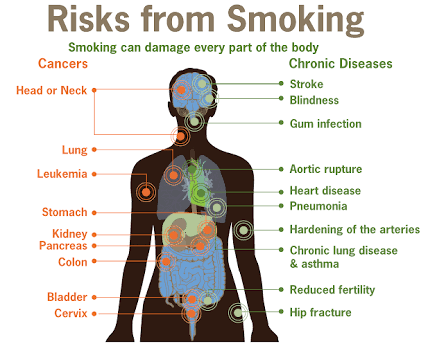
No matter how you smoke it, tobacco is dangerous to your health. There are no safe substances in any tobacco products, from acetone and tar to nicotine and carbon monoxide. The substances you inhale don’t just affect your lungs. They can affect your entire body.
Smoking can lead to a variety of ongoing complications in the body, as well as long-term effects on your body systems. While smoking can increase your risk of a variety of problems over several years, some of the bodily effects are immediate. Learn more about the symptoms and overall effects of smoking on the body below.
No matter how you smoke it, tobacco is dangerous to your health. There are no safe substances in any tobacco products, from acetone and tar to nicotine and carbon monoxide. The substances you inhale don’t just affect your lungs. They can affect your entire body.
Smoking can lead to a variety of ongoing complications in the body, as well as long-term effects on your body systems. While smoking can increase your risk of a variety of problems over several years, some of the bodily effects are immediate. Learn more about the symptoms and overall effects of smoking on the body below.


Tobacco smoke is incredibly harmful to your health. There’s no safe way to smoke. Replacing your cigarette with a cigar, pipe, or hookah won’t help you avoid the health risks.
Cigarettes contain about 600 ingredients, many of which can also be found in cigars and hookahs. When these ingredients burn, they generate more than 7,000 chemicals, according to the American Lung Association. Many of those chemicals are poisonous and at least 69 of them are linked to cancer.
In the United States, the mortality rate for smokers is three times that of people who never smoked. In fact, the Centers for Disease Control and Prevention (CDC) says that smoking is the most common “preventable cause of death” in the United States. While the effects of smoking may not be immediate, the complications and damage can last for years. The good news is that quitting smoking can reverse many effects.
Central nervous system

One of the ingredients in tobacco is a mood-altering drug called nicotine. Nicotine reaches your brain in mere seconds and makes you feel more energized for a while. But as that effect wears off, you feel tired and crave more. Nicotine is extremely habit-forming, which is why people find smoking so difficult to quit.

Physical withdrawal from nicotine can impair your cognitive functioning and make you feel anxious, irritated, and depressed. Withdrawal can also cause headaches and sleep problems.